




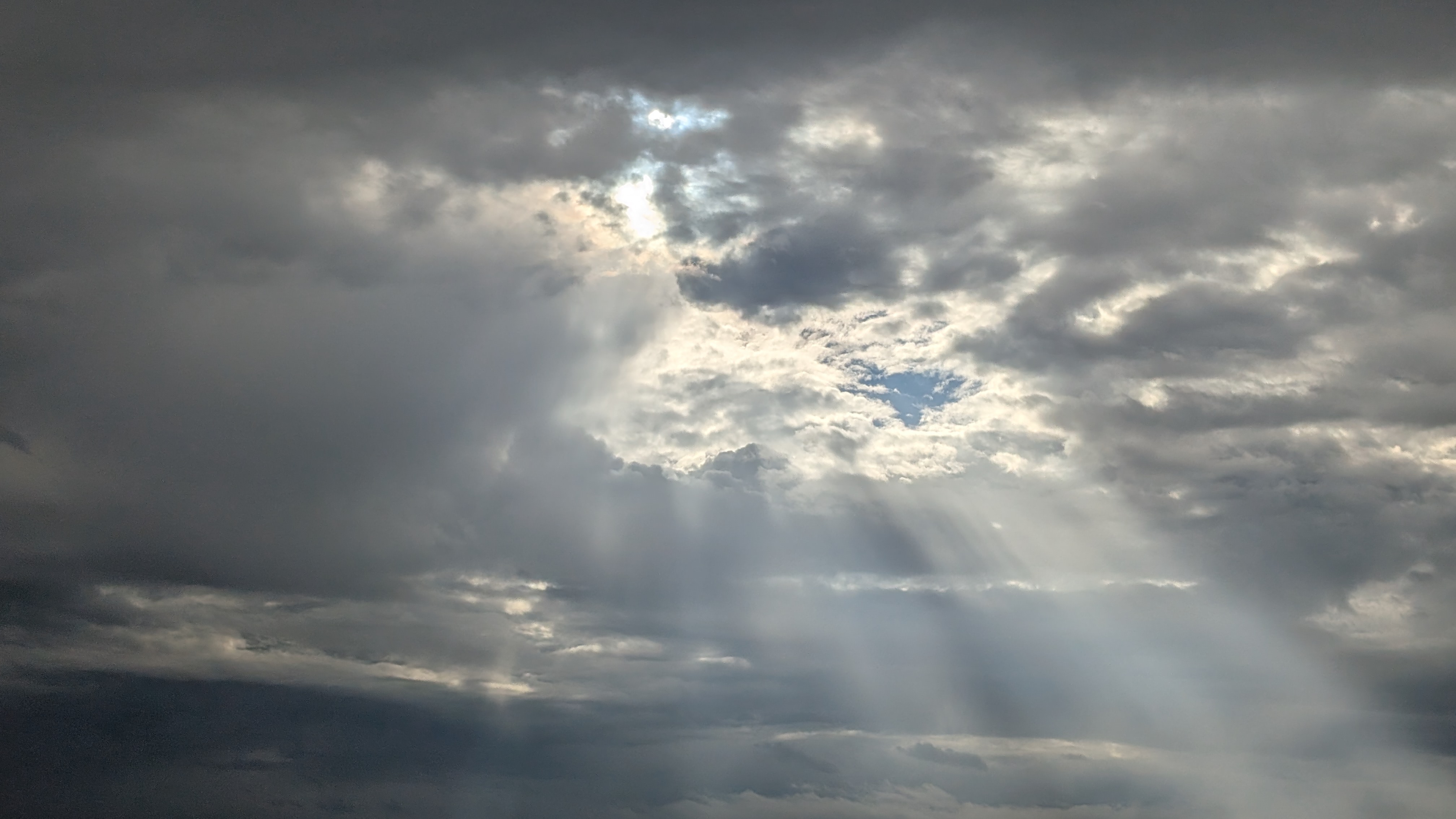
The Man in the Sky
Letting go of the patriarchal, righteous, punitive God we’ve all internalized, learning how the idea of God as a coping mechanism falls apart, and understanding God as simply what is.
The Pattern
You reach for something to quiet the noise. Maybe it’s a drink—two beers after work that become four, then six. Or pills that were supposed to help you sleep but now you can’t sleep without them. Maybe it’s the relentless scroll through your phone at 2 AM, the compulsive checking of email for the message that will finally make everything okay, the third pint of ice cream, the affair that distracts from the marriage you can’t fix. Saying yes when you mean no, morphing yourself into whatever keeps the peace, making yourself indispensable so no one can leave. Or maybe it’s work itself—the 70-hour weeks, the perfectionism that keeps you safe as long as you never stop moving, the productivity that proves you’re worth something.
At first, it works. The relief is real. The chaos quiets. You feel like you can breathe again.
Then you need it more often. The dose increases. The behavior intensifies. What used to quiet the noise now barely touches it. You tell yourself you’ll stop tomorrow, next week, after this project, after the holidays, after things settle down. But things don’t settle down. And you can’t stop reaching for it anyway.
“The thing you reached for to cope becomes the thing you’re coping with. The drink that quieted your anxiety now gives you anxiety.”
The thing you reached for to cope becomes the thing you’re coping with. The drink that quieted your anxiety now gives you anxiety. The work that made you feel valuable now isolates you. The people pleasing that kept you safe required abandoning yourself so completely you no longer know who you are or what you actually want. The control that made you feel safe now exhausts you. The spiritual practice that was supposed to transcend suffering now bypasses it, leaving you numb and disconnected, insisting “everything happens for a reason” while your life falls apart.
You try something else. A different strategy. A new approach. You white-knuckle it with willpower. You try surrendering to “the universe.” You swing between forcing outcomes and pretending you don’t care about outcomes. You manage to quit one thing only to find yourself compulsively doing another. You attend the workshop, read the book, follow the program. Some of it helps. None of it lasts.
“Reality keeps not matching your preferences, and no amount of strategy makes that tolerable for long.”
What’s underneath doesn’t go away. The anxiety, the grief, the rage, the emptiness, the chronic pain, the impossible relationship, the job that’s killing you, the parent you’re caring for, the child you lost, the body that won’t cooperate, the trauma that won’t stop replaying. Reality keeps not matching your preferences, and no amount of strategy makes that tolerable for long.
You’ve tried controlling reality. You’ve tried accepting reality through spiritual platitudes. You’ve tried medicating reality away. You’ve tried ignoring reality until it forced your attention. You’ve tried everything you can think of, and you’re standing in a place where all the strategies have been exhausted. Nothing left to try on the horizontal plane. The only direction that remains is up—but you don’t know what that means, and you’re not sure you believe there is an “up.”
“The exhaustion you feel is real. The sense that nothing works is real because nothing does work.”
This isn’t about you not trying hard enough. You’ve tried with everything you have. The exhaustion you feel is real. The desperation is real. The sense that nothing works is real because, on the level you’ve been operating, nothing does work. Not for long. Not in a way that doesn’t eventually create new problems.
What follows is for anyone who suffers—whether you’re religious, atheist, spiritual, or skeptical. Whether you’ve rejected God entirely or you’re seeking deeper understanding of what you already believe. Because this isn’t about believing in God. It’s about understanding how it all actually works. Understanding this is necessary if you want to suffer less. This is behind the origination of what religions and cultures understood before the concepts got distorted. It’s still underneath our nose. We’ve just stopped seeing it.
But there’s another way. Not another strategy to add to the list you’ve already tried. Not another technique for managing reality or transcending it. Another way of relating to reality itself—one that doesn’t require force or bypass, control or surrender to cosmic forces that don’t exist. It requires something harder and simpler: seeing what actually is, rather than what you’ve been taught to see.
The Problem With The Old Gods
Most of us inherit a God we never chose. He might appear as the stern judge tallying sins and distributing punishment. He might show up as the loving father who nonetheless allows terrible things to happen “for a reason we can’t understand.” He might be the cosmic accountant who rewards good behavior and punishes bad, the celestial parent who will fix things if we pray hard enough, or the universal energy that “aligns” with us when we’re spiritually evolved and abandons us when we’re not.
These are not just theological concepts. They’re psychological structures. They shape how we interpret suffering, how we relate to uncertainty, how we understand cause and effect, and how we cope when reality refuses to cooperate with our preferences.
“This God turns reality into a scoreboard and your life into a constant test you’re apparently failing.”
The punitive God tells you suffering is evidence of your inadequacy. If bad things are happening, you must have done something wrong. If you’re struggling, you’re being punished. If you can’t make it work, God is withholding blessing until you get it right. This God turns reality into a scoreboard and your life into a constant test you’re apparently failing. Every hardship becomes evidence of cosmic disapproval. Every struggle means you’re not praying right, not believing right, not trying right.
Under this framework, you develop hypervigilance—a constant monitoring of your behavior to avoid divine punishment. You live in fear of doing the wrong thing, thinking the wrong thought, wanting the wrong outcome. The anxiety this creates is profound. You’re not just dealing with life’s difficulties; you’re dealing with the added weight of cosmic judgment. And when you inevitably fail to control outcomes through perfect behavior, you have two choices: blame yourself for not being good enough, or blame God for being unfair.
“The bypass God takes observable truths about how reality works and adds cosmic intention that isn’t there.”
The bypass God takes truths and twists them into avoidance. “Everything happens for a reason.” “You’re exactly where you need to be.” “The universe is conspiring for your highest good.” These aren’t lies – they’re true. Everything does happen for a reason: lawful causation, cause and effect. You are exactly where you are because you can’t be anywhere else. Reality does tend toward life, toward continuation. The problem is what these truths become when you use them to skip over grief.
“Everything happens for a reason” stops meaning “reality operates lawfully” and starts meaning “your suffering serves a cosmic purpose designed for you.” “You’re exactly where you need to be” stops meaning “this is where you are, accept it” and starts meaning “don’t try to change anything, it’s all perfect.” “The universe is conspiring for your highest good” stops meaning “reality tends toward life” and starts meaning “this terrible thing is actually good for you.”
Suffering can teach you – but it’s not a lesson designed specifically for your growth. Pain often accompanies growth – but pain isn’t growth itself. Trauma shapes you – but it wasn’t “meant to happen” so you could become who you’re supposed to be. The bypass God takes observable truths about how reality works and adds cosmic intention that isn’t there. It spiritualizes cause and effect into divine curriculum. It turns acceptance into passivity. It confuses seeing what is with approving of what is.
“The bypass God asks you to fake peace while your insides scream, to spiritualize away your legitimate pain.”
This sounds compassionate until you try to live it. Until you’re sitting with grief that won’t resolve into a lesson. Until the chronic pain doesn’t reveal its purpose. Until the injustice you experienced refuses to transform into wisdom. The bypass God asks you to pretend that acceptance means everything is fine, to fake peace while your insides scream, to spiritualize away your legitimate pain. It replaces genuine reckoning with toxic positivity. It treats your rage at injustice as a spiritual failing. It confuses numbness with serenity.
Then there’s the Santa Claus God—the cosmic concierge who manages outcomes based on your alignment, your manifesting, your energy, your faith. Ask and you shall receive. Visualize and it will come. Get spiritually aligned and life will flow. This God treats the universe like a vending machine: insert the right spiritual currency and get what you want. When it doesn’t work—and it doesn’t work, not reliably, not for long—you’re left thinking you didn’t believe hard enough, didn’t align properly, didn’t manifest correctly. You failed at the spiritual technique.
All three of these Gods—the punitive judge, the cosmic life coach, and the universal vending machine—share the same fundamental flaw: they’re incompatible with observable reality. Bad things happen to good people. Good things happen to terrible people. Children get cancer. Narcissists prosper. The honest person loses their job while the con artist succeeds. Prayers go unanswered. Alignment doesn’t prevent catastrophe. Spiritual practice doesn’t make you immune to tragedy.
“They take suffering and add existential crisis. They take pain and add cosmic betrayal.”
And here’s why this is so difficult: letting go of these broken God concepts can feel like letting go of your only power. The punitive God at least gives you a framework where good behavior might protect you. The bypass God at least gives you meaning to wrap around senseless suffering. The Santa Claus God at least gives you something to do—manifest, align, attract. Giving these up can feel like surrendering your last defense against a chaotic, uncaring universe. It can feel like admitting there’s no protection, no meaning, no control at all.
But here’s what’s worse: these God concepts don’t just fail intellectually. They devastate emotionally. They take suffering and add existential crisis. They take pain and add cosmic betrayal. They take grief and add theological confusion. If you’ve lost a child, the punitive God makes you wonder what you did to deserve it. The bypass God tells you it happened for a reason you’ll understand someday. The Santa Claus God suggests you didn’t manifest properly. All three add insult to injury.
And if you’re someone who has legitimate reasons to be angry—and you do, if you’ve experienced real trauma, real injustice, real loss—these God concepts give you nowhere to put that anger except at God himself. The punitive God you rage at for being cruel. The bypass God you rage at for the false comfort. The Santa Claus God you rage at for not showing up when you did everything right. Your anger feels justified because it is justified. These Gods are worthy of rage. They’re false. They contradict what you can see with your own eyes about how reality actually works.
“What if your rage at them, your exhaustion from trying to believe them—what if all of that is evidence that you’re seeing clearly?”
The tragedy is that your rage at “God” is actually rage at these broken concepts. You’re not angry at reality itself. You’re angry at the lie that reality operates according to human moral frameworks, that suffering is punishment or lesson or manifestation failure. You’re angry at the cosmic gaslighting that tells you to interpret your pain as divine plan or karmic debt or spiritual opportunity. You’re furious at the theology that takes the hardest moments of human existence and wraps them in explanations that insult your intelligence and your grief.
But here’s the hope: what if the reason these concepts feel so wrong is because they are wrong? What if your rage at them, your inability to make them work, your exhaustion from trying to believe them—what if all of that is evidence that you’re seeing clearly? The anger doesn’t mean God (rightly understood) isn’t real. It means these versions of God were false from the start. The problem isn’t that reality is incompatible with God. The problem is that these Gods are incompatible with reality.
What if there’s a way to understand God that doesn’t contradict what you can observe about how the world actually works? What if there’s a frame that allows for grief without adding cosmic injustice, that acknowledges randomness without concluding everything is meaningless, that admits you can’t control outcomes without leaving you helpless? You don’t have to choose between a God who makes no sense and a universe that cares nothing about your suffering. There’s another option. But it requires letting go of the man in the sky entirely.
What God Actually Is
Strip away the theology. Strip away the cultural overlays, the religious institutions, the anthropomorphic projections. What remains?
Reality itself. The coherent order by which existence unfolds. Not chaos. Not randomness. Not personal whim. Pattern. Law. The way things actually work.
This isn’t cold mechanism. This is the recognition that reality operates according to principles that don’t bend to preference. A seed becomes a tree through lawful process. Gravity acts consistently. Cause leads to effect through traceable pathways. The universe isn’t arbitrary, and it isn’t personal. It’s structured. It has order. That order is what we might call God—not as a being who watches and judges and intervenes, but as the fundamental nature of existence itself.
This understanding appears at the heart of ancient wisdom traditions, though the language differs. In Taoism, it’s the Tao—the Way, the underlying order that flows naturally when not obstructed by force. In Buddhism, it’s the dependent origination of all phenomena, the recognition that everything arises through interconnected causes with no separate, independent existence. In Advaita Vedanta, it’s Brahman—ultimate reality that is identical with the true self, obscured only by the illusion of separation. In Indigenous wisdom, it’s the recognition that all things are related, that humans are part of nature rather than above it, that the pattern that flows through the river flows through you. In the Kybalion, it’s the principles of correspondence, cause and effect, rhythm—reality operating according to lawful patterns that repeat across all scales, from thought to matter, from atom to cosmos. Even quantum physics points toward it: the observer and observed aren’t separate entities, reality is interconnected processes rather than isolated objects, the patterns repeat across scales.
“That order is what we might call God—not as a being who watches and judges, but as the fundamental nature of existence itself.”
This is what religions began as: transmission systems. When someone recognizes this pattern—that reality itself is the divine order—they naturally want others to have this understanding too. To suffer less. To struggle less. So they build frameworks to help others see what they saw. Stories that point at the pattern. Rituals that create conditions for recognition. These look different depending on the culture—the story that works for a desert nomad looks different than the one that works for a Chinese farmer—but the recognition they point to is the same. The problem isn’t that they tried. The problem is that over time, the framework becomes the thing. The stories become literal. The metaphors become dogma. The pointer replaces the object. And we are left with the man in the sky—worshiping the map rather than walking the territory.
This isn’t about converting to Eastern philosophy or Indigenous spirituality or Hermetic philosophy. This is about recognizing what’s always been true beneath the cultural expressions: reality has structure. That structure doesn’t respond to human preference. Understanding and aligning with that structure reduces suffering. Resisting it increases suffering. This is observable. This is testable. This is what the wisdom traditions point toward when they speak of God, enlightenment, the Way, liberation. You don’t have to use any of these words—God, enlightenment, the Way. You can call it reality, physics, nature, or nothing at all. The understanding matters, not the language.
But let’s be clear about what this is not. This is not “everything happens for a reason” repackaged in more sophisticated language. Things don’t happen because some cosmic intelligence planned them for your growth. Things happen because reality unfolds according to its nature. A tree doesn’t fall in the forest because the universe wanted to teach you about impermanence. It falls because of wind, age, rot, physics. There’s order in that—cause and effect, pattern and process—but there’s no intention. No message. No lesson designed specifically for you.
“Over time, the framework becomes the thing. The stories become literal. The metaphors become dogma. And we are left with the man in the sky.”
This is also not the idea that reality is just matter in motion, meaningless particles doing meaningless things. The order isn’t mechanical in the sense of dead. It’s the living structure of existence itself. The interconnection of all things isn’t metaphor—it’s how reality actually works. You aren’t separate from the air you breathe, the food you eat, the people you love, the bacteria in your gut, the ecosystem you’re part of. The boundaries between self and other are useful fictions, not ultimate truths. The pattern that governs a galaxy governs a cell. As above, so below—not as mystical poetry, but as observable correspondence across scales.
This understanding is why cultures across millennia have spoken of Mother Earth and Father Sky. Not as metaphor, but as recognition of what actually is: the ground that holds you, the vast expanse above you, the coherent order flowing through both. When you look at clouds moving, grass growing, a bird in flight, a tree reaching toward light—you’re seeing the divine itself. Reality expressing itself. The pattern unfolding.
This is what omnipresent actually means: not a being who exists everywhere, but existence itself as the everywhere. Omniscient not as a mind that knows everything, but as reality knowing itself through every form—through the tree’s growth toward sun, through your consciousness reading these words, through the mathematics governing galaxies and cells. The pattern in everything you look at, think about, or feel. It’s literally everywhere.
“When you look at clouds moving, grass growing, a bird in flight—you’re seeing the divine itself. Reality expressing itself.”
God, in this frame, is not managing your outcomes. God is not deciding whether your prayer gets answered. God is not weighing your karma or testing your faith or planning your suffering. God is the way reality is structured. The lawful unfolding. The coherent pattern. The interconnected whole in which you exist as a temporary expression, made of the same substance as everything else, following the same principles as everything else, subject to the same forces as everything else.
This sounds cold when you’re in pain. When you’re grieving. When you’re watching injustice unfold. When your body is failing. When the person you love is dying. When the child you carried won’t live. You want God to care. You want God to intervene. You want your suffering to mean something, to be noticed, to matter in the cosmic scheme.
And here’s why that’s so hard to let go: the broken God concepts taught you that reality should respond to goodness, to prayer, to right action, to spiritual development. They taught you that if you suffer, someone or something is to blame—either you for failing, or God for allowing it. They taught you that the universe should care about your preferences. That justice should prevail. That meaning should be inherent in events.
“The broken God concepts taught you that if you suffer, someone or something is to blame—either you for failing, or God for allowing it.”
But what if reality doesn’t work that way? What if the order is lawful but not moral? What if cause and effect operate consistently but without judgment? What if your suffering is real and terrible and not because anyone—divine or otherwise—decided you should suffer?
Here’s the hope: this frame allows grief without existential collapse. You can mourn without thinking you deserved it. You can rage at injustice without thinking the universe is inherently unjust. You can experience terrible things without concluding that God is either cruel or non-existent. Reality can be devastating and trustworthy at the same time. Trustworthy not because it will protect you, but because it operates according to principles you can learn to work with rather than against.
When you jump from a second-floor window, you break bones. Not as punishment for jumping. Not as a lesson about gravity. Just as the natural consequence of impact. Gravity doesn’t care about your intentions. It acts consistently. That’s not cruel. That’s just what gravity does. And knowing how gravity works doesn’t make the broken bones hurt less, but it does free you from thinking you’re being punished. You’re not being judged. You’re experiencing consequence.
“You’re not a separate thing existing in an indifferent universe. You’re the universe experiencing itself temporarily as you.”
The same principle applies to emotional and psychological reality. What you resist persists. What you suppress expresses itself in shadow behavior. When you don’t process grief, it shows up as depression or physical illness or numbness or rage. Not because you’re being punished for not processing it properly, but because that’s how the psyche works. It’s lawful. It’s patterned. It’s reliable. And when you understand that, you’re not adding cosmic judgment to human suffering. You’re working with the way things actually are.
This is what God actually is: the way things actually are. The structure. The pattern. The interconnected, lawful, coherent unfolding of existence itself. And if that still feels cold, consider this: you are not separate from that pattern. You are an expression of it. The intelligence that looks through your eyes is the same intelligence that grows the tree and forms the galaxy. The grief you feel, the love you experience, the consciousness that’s aware of itself—that’s not separate from the divine order. That is the divine order becoming aware of itself through you. You’re not a separate thing existing in an indifferent universe. You’re the universe experiencing itself temporarily as you. This doesn’t make the suffering stop. But it changes the relationship to it. And that changes everything.
What Faith Actually Is
Faith has been sold as believing impossible things. As holding onto hope when evidence says otherwise. As trusting God will fix it, provide, intervene, come through. That’s not faith. That’s magical thinking dressed in religious language.
Real faith is not belief in protection. It’s not confidence that things will work out. It’s not the certainty that suffering serves a purpose. Real faith is the capacity to remain open when reality doesn’t match your preference. It’s the willingness to stay present with what is rather than fragment into what should be.
Faith is not saying “everything happens for a reason.” Faith is saying “this is happening, and I don’t have to understand why to stay here with it.” It’s not resignation. It’s not approval. It’s not pretending you’re fine with it. It’s the refusal to let the unacceptable make you collapse into denial, bypass, or control.
“Reality doesn’t match the preference. You resist. The resistance creates suffering that’s distinct from the pain.”
The core mechanism works like this: Reality delivers something. You have a preference. Reality doesn’t match the preference. You resist. The resistance creates suffering that’s distinct from the pain of the original circumstance. The pain might be unavoidable. The suffering is the resistance itself.
Faith, in this frame, is the capacity to let the preference go. Not to stop caring. Not to become passive. Not to approve of injustice or abuse or cruelty. But to stop insisting that reality rearrange itself to match your picture of how it should be. To accept what is, which is the only thing that ever actually exists—what is—rather than exhausting yourself fighting for what isn’t but should be.
This sounds like betraying yourself. Like letting yourself be crushed. Like giving up your only power, which is the refusal to accept the unacceptable. And this is where people get stuck, because the culture teaches us that acceptance is weakness. That if you accept something, you’re complicit with it. That staying angry, refusing to make peace with it, is somehow a form of power.
“The thing happened. It’s already happened. No amount of non-acceptance makes it un-happen.”
But refusal is what’s exhausting you. The thing happened. It’s already happened. No amount of non-acceptance makes it un-happen. The job you lost, the relationship that ended, the diagnosis you received, the betrayal you experienced, the person who died, the childhood you didn’t get—it already is. The refusal to accept that it is doesn’t change that it is. It just adds resistance to reality. It adds suffering to pain.
Faith is what allows you to grieve without collapsing. To rage without destroying yourself. To protest injustice while accepting that injustice happened. You can fight to prevent it from happening again without refusing to accept that it happened. You can work for change while acknowledging what is. You can care deeply about outcomes while releasing the illusion that your caring controls outcomes.
The serenity prayer points at this, though it’s usually misunderstood. Grant me the serenity to accept what I cannot change, the courage to change what I can, and the wisdom to know the difference. The wisdom is knowing that you can never change what already is. You can only change what comes next. Fighting with what already is only depletes the energy you need for what comes next.
“Acceptance doesn’t mean what happened was okay. It means it happened. Past tense. Already done.”
But here’s what makes this so difficult: acceptance feels like giving up your protest. If you’re someone who has experienced real injustice—abuse, discrimination, exploitation, violence—the idea of “accepting” it feels obscene. It feels like letting the perpetrator off the hook. It feels like betraying your younger self who needed someone to say “this is wrong, this should not have happened.”
And you’re right. It was wrong. It should not have happened. The person who hurt you was responsible. The system that allowed it was unjust. None of that changes with acceptance. Acceptance doesn’t mean what happened was okay. It means it happened. Past tense. Already done. The injury occurred. And what you do with the injury now—whether you let it define you, whether you stay in the fight-or-flight response indefinitely, whether you carry the rage like a shield against future harm—that’s what’s still in your control.
Faith is trusting that you can put down the shield without being defenseless. That you can stop bracing against what already happened without being complicit with what happened. That you can acknowledge “this is real, this happened to me, this hurt me, this was wrong” without staying in permanent resistance to the fact that it occurred.
“When you stop insisting reality should be different than it is, you can actually see what is—and seeing clearly is the only way to work with it.”
Here’s the hope: acceptance creates capacity. When you stop using all your energy fighting with what is, you have energy for what’s possible. When you stop insisting reality should be different than it is, you can actually see what is—and seeing what is clearly is the only way to work with it. Acceptance doesn’t make you passive. It makes you effective. Because you’re dealing with reality instead of with your picture of what reality should be.
This is faith. Not believing God will fix it. Not trusting the universe has a plan. Not hoping for divine intervention. Faith is the willingness to be with what is, even when what is breaks your heart. To stay present. To keep breathing. To let reality be reality without requiring it to be something else first. To trust that you can survive contact with the truth.
The Integration
Here’s where it gets strange: you can’t have one without the others. The God-concept enables faith. Faith requires this God-concept. Both require acceptance. And acceptance becomes possible only when you have the right God-concept and the capacity for faith. They’re circular. Interdependent. You can’t approach them linearly.
Any God-concept based on transaction or moral judgment makes acceptance impossible. You cannot accept reality if you believe it’s a test you’re failing or a code you haven’t cracked.
But if you understand God as the lawful structure of reality itself—as the coherent order that doesn’t respond to preference—then acceptance becomes possible without those distortions. You can accept that something happened without thinking you deserved it. You can accept that suffering exists without pretending it’s fine. You can accept that you can’t control outcomes without concluding you’re powerless.
“When you’re refusing reality, you need God to be someone who might change reality.”
And here’s the strange loop: you can’t fully understand this God-concept until you’ve begun to accept. Because transactional God-concepts feel true when you’re in resistance. When you’re refusing reality, you need God to be someone who might change reality. The idea that God is just the way things are feels cold and insufficient when you’re desperate for things to be different.
But when you start to accept—even just experimentally, even just for a moment—this God-concept starts to make sense. You feel the relief that comes from not having to manage cosmic forces. You feel the clarity that comes from working with reality as it is rather than as it should be. You feel the strange freedom that comes from recognizing you’re not separate from the pattern but an expression of it.
And that acceptance makes that capacity we call faith possible. It emerges when you’re not using all your energy fighting what is. When you stop bracing against reality, space opens. In that space, you can stay present with difficulty rather than collapsing into control or avoidance.
“The way out isn’t another doing. It’s a shift in seeing that only becomes possible when you’ve exhausted the doing.”
But you can’t force your way into this circle. This is why it feels impossible when you’re still in the middle of it—when you’re still trying strategies, still hoping this next thing will work, still thinking in terms of what to do. The way out isn’t another doing. It’s a shift in seeing. But that shift only becomes possible when you’ve exhausted the doing. Standing in that exhaustion is what makes transcendence possible—not because exhaustion is noble, but because the willingness to look up only comes when you’ve verified there’s nowhere left to go horizontally.
And here’s why this is particularly hard when you have good reasons to be angry: the shift feels like letting the universe off the hook. Like saying it’s fine that terrible things happen. Like forgiving the unforgivable. Your anger has been your power, your protection, your way of saying “this was wrong.” The idea of letting that go—even when the anger exhausts you, even when it keeps you stuck—feels like betraying yourself or others who were harmed.
But the shift isn’t about letting anyone off the hook. It’s about recognizing that the hook you’re holding them on is also hooked into you. Your refusal to accept what happened doesn’t harm them. It harms you. Your insistence that reality should have been different doesn’t change what was. It just keeps you in relationship with what was rather than what is.
“The hook you’re holding them on is also hooked into you. Your refusal to accept what happened doesn’t harm them. It harms you.”
This integration isn’t about making peace with harm. It’s about recognizing that harm happened (past tense), and that refusing to accept it happened doesn’t undo it—it just exhausts you.
Here’s the hope: each small crack in the system makes the next one easier. One moment of genuine acceptance shows you it doesn’t mean approval. One moment of staying present with difficulty shows you it doesn’t destroy you. These moments don’t happen through effort. They happen when effort exhausts itself—when you can’t make it happen, but you recognize it when it’s happening.
This is transcendence. Not leaving the body or ascending to higher consciousness or achieving some rarefied spiritual state. Just the movement from horizontal strategies to vertical recognition.
What Becomes Possible
When you stop using all your energy fighting reality, something opens.
You can grieve without collapsing. The loss remains a loss. The pain doesn’t disappear. But you can be with it without fragmenting into a thousand pieces, without needing it to not be true, without making it mean something cosmic about your worth or God’s cruelty or the universe’s indifference. You can cry without thinking you’re falling apart. You can feel the weight without being crushed by it. Grief moves through you rather than defining you.
You can act without forcing. You can engage fully with what’s in front of you—the work, the relationship, the crisis, the opportunity—without needing to control the outcome. You do what you can do, and then you let go of whether what you did was enough. Not because you don’t care, but because your caring doesn’t determine outcomes. Reality determines outcomes according to its own lawful unfolding, and your job is to participate in that unfolding with as much skill and presence as you can, not to guarantee results through force of will.
“You do what you can do, and then you let go of whether what you did was enough.”
You can let go while still engaging. This sounds contradictory until you feel it. You can care deeply about whether your child gets well while accepting that you can’t make them get well. You can work for justice while accepting that justice might not come. You can love someone who’s leaving without refusing the truth that they’re leaving. Letting go of the outcome doesn’t mean stopping the action. It means the action isn’t distorted by the desperate need to control what you can’t control. You’re more effective when you’re not in white-knuckled attachment to specific results.
You’re less defended. You don’t need the same level of protection because you’re not as afraid of reality. The worst thing you were defending against—loss, failure, rejection, pain—you’ve discovered you can survive. Not because it doesn’t hurt, but because hurt doesn’t equal destruction. You can be vulnerable without being fragile. You can be open without being naive. You can feel without drowning in feeling.
You’re more present. When you’re not fighting what is or defending against what might be, you’re actually here. Not in the past refusing what happened or in the future controlling what might happen. Here. With this breath. This moment. This person. This situation exactly as it is. There’s a strange peace in that, not because everything is peaceful, but because you’re not adding resistance to difficulty.
“The worst thing you were defending against—loss, failure, rejection, pain—you’ve discovered you can survive.”
Recognition is different from belief. Belief is adopting an idea. Recognition is seeing what’s already here. Look at a tree outside. Watch how it grows without needing to know if it’s doing it right, without trying to control the outcome. It participates in reality according to its nature. The bird flies. The grass pushes through concrete. None of it requires management. They are reality working. And so are you. When you’re not fighting what is, you realize you don’t have to manage your existence either; you just have to participate in it.
You’re more resilient. Not the kind of resilience that means you never break. The kind that means you break and don’t shatter. You bend without snapping. You feel the full force of what hits you without being destroyed by it. You recover not because you’re strong but because you’re not rigid. The tree that survives the storm isn’t the one that refuses to bend. It’s the one that bends without breaking, that moves with the wind rather than against it.
This doesn’t mean the pain goes away. Your chronic illness still hurts. The person you lost is still gone. The job you can’t stand still exhausts you. The relationship that’s failing still breaks your heart. The childhood trauma still has effects. The injustice you experienced is still unjust. None of that changes. What changes is your relationship to it. And that makes the difference between pain and suffering, between difficulty and destruction, between being broken and being shattered.
“Recognition is different from belief. Belief is adopting an idea. Recognition is seeing what’s already here.”
Compare this to life without this understanding: you’re in perpetual crisis management, oscillating between hypervigilance and collapse, exhausting yourself with resistance. But with the integration—the right understanding of God, the faith as capacity, the acceptance as clarity—there’s a different foundation. Reality can be devastating without you being devastated. Life can be hard without you being brittle. You can face what’s true without it destroying you because you’re not adding the layer of resistance that turns pain into suffering, difficulty into crisis, limitation into failure.
This doesn’t make you impervious. You still feel everything. Actually, you feel more because you’re not numbing or avoiding or defending. But the feeling doesn’t destroy you because you’re not making it mean what it doesn’t mean. The grief doesn’t mean you’re broken. The fear doesn’t mean you’re in danger. The anger doesn’t mean you’re bad. The pain doesn’t mean God is punishing you or the universe is against you or you did something wrong. It just means you’re human, experiencing what humans experience when reality doesn’t match preference.
And here’s what’s strange: this is when you finally have real choice. Not the illusion of control over outcomes, but actual choice about how you engage with what is. You can choose how to respond rather than just reacting from fear or resistance. You can choose where to put your energy rather than spending it all on fighting what you can’t change. You can choose what to accept and what to work to change, with the wisdom to know the difference, because you’re seeing clearly instead of through the distortion of refusal.
“What changes is your relationship to it. And that makes the difference between pain and suffering, between difficulty and destruction.”
This is what’s possible. Not a life without pain. Not protection from loss. Not the guarantee that things will work out. Not transcendence of difficulty. But the capacity to be with all of it without it destroying you. The capacity to engage fully without needing to control. The capacity to love without guarantees. The capacity to participate in reality as it is rather than exhausting yourself insisting it be different.
None of this happens all at once. You don’t suddenly achieve this and then have it forever. It’s a capacity you develop through use, that strengthens over time, that you forget and remember and forget again. But each time you remember, each time you feel the relief that comes from dropping the resistance even briefly, each time you notice you’re with what is rather than fighting what is, the capacity grows. Not because you’re getting better at it, but because you’re recognizing what was always true: reality is bearable when you stop fighting the fact that it’s real.
This is the difference. Not between having problems and not having problems. Between being human in a difficult world with a framework that allows you to be with that difficulty, and being human in a difficult world with only resistance and control and bypass as options. One is exhausting. One isn’t. Not because it’s easy, but because you’re not adding the exhaustion of fighting reality on top of the difficulty of living it.
“The grief doesn’t mean you’re broken. The fear doesn’t mean you’re in danger. It just means you’re human.”
And here’s the final piece: this isn’t just about you. When you’re not using all your energy managing yourself, you have energy for others. When you’re not defended against your own pain, you can be present with someone else’s. When you’re not trying to control outcomes, you can actually show up for what’s needed. The same acceptance that allows you to be with your own grief allows you to be with someone else’s without trying to fix it. The same faith that lets you engage without forcing outcomes lets you support someone else without taking over. The same understanding of God that frees you from cosmic judgment lets you meet others without judging them.
This is what becomes possible. Not a life without suffering. Not immunity from loss or protection from pain. But the capacity to be with all of it—yours and others’—without fragmenting, without forcing, without the exhaustion that comes from perpetual resistance. The capacity to participate in reality as it is, which is the only place any real change or connection or meaning ever was.
The Man in the Sky
The God you inherited doesn’t work. And you were right to rage at it. But you don’t have to choose between a God who makes no sense and a universe that doesn’t care. There’s a third option that’s been there all along, beneath the theology and the cultural overlays and the anthropomorphic projections: reality itself has structure. Coherent order. Lawful unfolding. Interconnected wholeness. The wisdom traditions have been pointing at it for thousands of years, using different language, different metaphors, different practices, but pointing at the same thing: what actually is, rather than what we wish were.
“The way back isn’t through more knowledge. It’s through recognizing what you never actually left. You never left paradise. You just stopped seeing it.”
The story of the Garden of Eden points at this. Adam and Eve lived in paradise not because they were in a special place, but because they lived in faith—trusting the structure God created, participating directly in reality as it is. Then came the bite of the apple—the shift from faith to the need for knowledge, from trusting God’s order to needing to understand and control independently. When you recognize God everywhere—in the tree, in the breath, in the pattern itself—you realize through acceptance that there is nothing to know. Understanding comes through recognition, not through control. The moment they needed to know rather than trust, to analyze rather than participate, Eden vanished. Not because God cast them out, but because paradise disappears from perception the instant you stop recognizing it. You can’t see paradise when you’re trying to control it.
You knew this once. A child lives in direct recognition before we teach them separation, before we teach them the man in the sky, before we teach them they need to know and control and manage. But you can return. Not to unconscious innocence, but to conscious recognition. The way back isn’t through more knowledge. It’s through recognizing what you never actually left. You never left paradise. You just stopped seeing it.
“The suffering that came from trying to make that God real—from trying to believe hard enough or pray right enough or manifest properly enough—was suffering you never needed to bear.”
This God doesn’t manage your outcomes. Doesn’t reward or punish. Doesn’t intervene or withhold blessing. Doesn’t care about your preferences in the way a person cares. But this God is the ground in which you exist, the pattern that flows through you, the order you can align with rather than fight. And that’s not cold. That’s what makes genuine participation possible. When you’re not spending all your energy trying to control reality or bargaining with cosmic forces or bypassing your actual experience, you can actually be here. Present. Engaged. Alive in the way that’s only possible when you’re not at war with what is.
The man in the sky doesn’t work because that God doesn’t exist. The suffering that came from trying to make that God real—from trying to believe hard enough or pray right enough or manifest properly enough—was suffering you never needed to bear. But reality itself—the lawful structure, the coherent order, the pattern that flows through everything including you—that’s trustworthy. Not because it will give you what you want, but because it’s real. When you stop fighting what actually is, when you stop needing it to be something else first, when you can be with reality as it is rather than as it should be, that’s when you’re finally free. Free not from difficulty but from the additional suffering that comes from refusing difficulty. Free not from pain but from the layer of resistance that turns pain into torture. Free not from reality but for reality—for participating in what is, for engaging with what’s possible, for being here rather than perpetually fighting or bypassing or controlling.
“The exhaustion you feel isn’t from life. It’s from fighting life. Put it down.”
The exhaustion you feel isn’t from life. It’s from fighting life. And the way out isn’t another strategy for fighting better. It’s the recognition that the fight itself is what’s destroying you. Put it down. Not because what happened is fine. Not because you’re giving up. But because the energy you’re spending on refusing what was is energy you need for engaging with what is. You can be with all of it. And being with it is what you’ve been trying to achieve through every strategy, every practice, every attempt at control or transcendence. Mother Earth beneath your feet. Father Sky above you. Stop trying. Start seeing. The way is already here.